







A few weeks ago, a friend of mine messaged me in a bit of a panic. He'd been scrolling through Facebook groups looking for a freelancing course, and the prices he found made absolutely no sense to him. One institute was charging 3,000 taka for a "complete freelancing mastery" course. Another, teaching what looked like the exact same syllabus, wanted 35,000 taka.
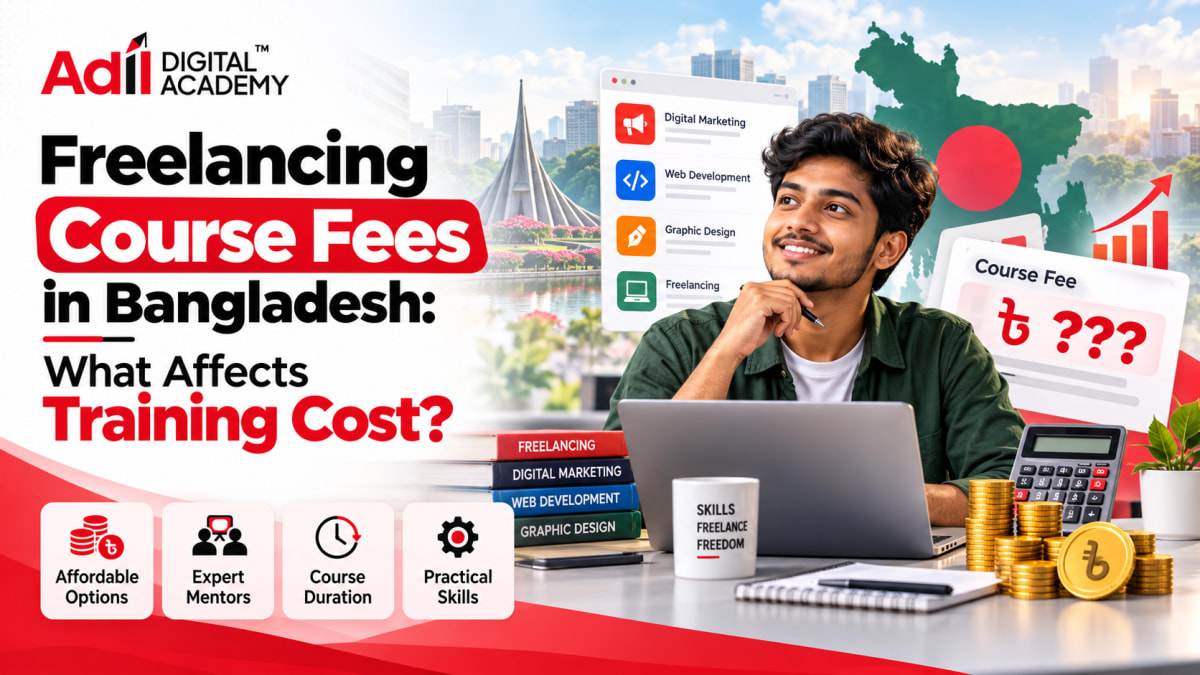
Freelancing course fees in this country span an enormous range, and the price tag alone rarely tells you whether a course is actually worth your money. In this guide, we'll walk through exactly what drives training costs up or down, how fees differ across skill categories, what hidden expenses you should watch for, and how to figure out whether you're getting real value for what you're paying—regardless of your budget.
Overview of Freelancing Course Fees in Bangladesh
The freelancing training market in Bangladesh has grown massively over the last several years. What used to be a handful of local computer training centers has turned into a crowded landscape of small coaching centers, large private academies, government-backed programs, and online-only bootcamps. That growth is great for learners in one sense — there's more choice than ever — but it also means fees vary wildly depending on who's teaching, what's being taught, and how the course is delivered
Average Price Range for Beginner Courses
Entry-level courses — things like basic data entry, introductory graphic design, or virtual assistant training — tend to sit at the more affordable end of the spectrum. These courses are usually shorter in duration and focus on giving students a working foundation rather than deep specialization. Because the scope is narrower and the tools involved are simpler, institutes can keep the price relatively low while still delivering genuine value to a first-time learner.
Average Price Range for Advanced/Specialized Courses
On the other end, courses covering advanced web development, specialized digital marketing tracks, or UI/UX design command noticeably higher fees. These programs typically run longer, involve more one-on-one mentorship, and require instructors with deeper, more current industry experience. When you're paying more for a course like this, you're generally paying for depth — more hands-on projects, more feedback cycles, and a curriculum that's harder to replicate through free resources alone.
Key Factors That Affect Freelancing Course Fees
Understanding why prices differ is genuinely important, because without that context, you might end up overpaying for a mediocre course or, just as easily, skipping a course that would have actually been worth the investment because the price looked "too high" at first glance.
Institute Reputation and Trainer Expertise
Institutes with an established name and instructors who are themselves working, earning freelancers tend to charge more — and there's a logical reason for that. Learning from someone who has actually navigated Upwork's bidding wars or built a six-figure Fiverr gig carries a different kind of value than learning from someone reciting theory from a textbook. That said, reputation alone shouldn't be the deciding factor. It's worth digging a little deeper before paying a premium fee, just to confirm that the trainer's experience is as real as the marketing suggests.
Course Duration and Depth of Curriculum
A two-week crash course and a three-month comprehensive program are never going to be priced the same, and that's perfectly reasonable. The longer and more thorough a curriculum is, the more class hours, assignments, and instructor time go into delivering it — and fees naturally scale with that investment of time.
Live Mentorship vs Self-Paced Learning
There's a real difference between watching pre-recorded videos on your own schedule and sitting in a live class where you can ask a question the moment you get stuck. Because live mentorship requires the instructor's direct time and attention, courses built around live sessions typically cost more than self-paced, recorded alternatives.
One-on-One Support vs Group Batches
Similarly, one-on-one coaching or small-batch classes cost more than large group sessions, simply because the instructor can give each student individual attention. If you're someone who needs more personalized feedback to actually retain what you're learning, this extra cost can pay for itself many times over.
Certification and Post-Course Support
Whether a course includes a recognized certificate, and whether you can still reach out with questions after the course officially ends, often factors into the price as well. These "extras" aren't always obvious from a course listing, so it's worth asking directly before enrolling.
Free vs Paid Freelancing Courses: Which Is Worth It?
Many beginners wonder, “Why should I join a paid course when there are so many free resources available online?” It’s a valid question. Learning for free is possible, but the real challenge is knowing what to learn, where to start, and how to avoid wasting time on the wrong information. A structured course can make the learning journey easier, while self-learning requires more discipline and patience.
Pros and Cons of Free Courses
The biggest advantage of free courses is obvious: there's zero financial risk involved in getting started. YouTube alone now hosts a surprising amount of genuinely solid, up-to-date content on freelancing skills. The downside, though, is structure — or the lack of it. Free resources rarely offer a clear roadmap, there's no one to ask when you're stuck, and staying motivated without any accountability can be genuinely difficult for a lot of people.
When Paying for a Course Makes Sense
If you want someone to guide you step by step, a structured timeline that pushes you to actually finish rather than let the course sit half-watched, and a direct line to ask questions when something doesn't click — paying for a course is usually the smarter move. This is especially true for people who know, realistically, that they struggle to stay disciplined with self-directed learning. In that case, the fee is really buying you time and momentum, not just information.
Freelancing Course Fees by Skill Category
Pricing also varies quite a bit depending on which skill you're learning, largely because different skills carry different levels of complexity and require different kinds of instructor investment.
Graphic Design Course Fees
Graphic design courses generally sit in a mid-range price bracket. Beyond just teaching software, a good instructor also has to teach creative thinking and design sense, which takes more time to develop properly. That combination tends to push these courses slightly higher than the most basic offerings, and slightly longer in duration too.
Digital Marketing Course Fees
Digital marketing courses often carry a somewhat higher fee because the subject itself is broad — SEO, social media marketing, paid advertising, and content strategy are frequently bundled into a single program. That breadth means more material to cover, but it also tends to pay off well afterward, since demand for these skills in the freelance market remains consistently strong.
Web Development Course Fees
Web development training is usually among the more time-intensive — and therefore more expensive — categories. Learning to code properly simply takes longer than picking up most other freelance skills. But it's often a worthwhile investment in the long run, since skilled developers remain in high, steady demand across nearly every freelance marketplace.
Hidden Costs to Watch Out For
It's easy to assume the advertised course fee is the entire cost, but that's rarely the full picture. A few additional expenses are worth budgeting for before you commit.
Software, Tools, and Subscription Costs
Many courses require premium software subscriptions — think Adobe Creative Cloud, certain SEO tools, or specialized design platforms — that aren't included in the base course fee. Before enrolling, it's worth asking directly whether these tools are bundled into the price or need to be purchased separately.
Internet and Equipment Requirements
A stable internet connection and a reasonably capable device are non-negotiable for online training. If your current setup isn't quite up to the task, factor in the cost of upgrading before you start, since struggling with technical issues mid-course can seriously slow down your progress.
How to Get the Best Value for Your Money
Choosing based on price alone is a mistake, but so is assuming that the most expensive option is automatically the best one. The real skill here is finding the right balance.
Comparing Institutes Before Enrolling
Lay out the syllabus, reviews, and fees of a few different institutes side by side before deciding. Price is just one variable in that comparison — what you actually get for that price matters just as much, if not more.
Checking Refund and Guarantee Policies
Find out in advance whether you can get a refund if the course turns out not to be what you expected. A clear refund policy is often a decent signal that the institute stands behind the quality of what it's offering.
Is a Higher Course Fee Always Better?
Not necessarily. Sometimes a higher-priced course has excellent marketing but fairly shallow content underneath it. On the flip side, a more modestly priced course taught by a genuinely dedicated instructor can deliver far better results. Rather than anchoring your decision to the price tag, it's worth putting more weight on verified reviews, the depth of the curriculum, and how much practical, hands-on work is actually built into the program.
Budget-Friendly Freelancing Course Options in Bangladesh
If your budget is tight, government-backed programs like the Learning and Earning Development Project (LEDP) or a handful of trustworthy local training centers can be solid, low-cost entry points. A practical approach many successful freelancers follow is starting small — learning fundamentals affordably — and then reinvesting in more advanced, specialized training once they've built confidence and started earning.
At the end of the day, obsessing over the exact price tag of a freelancing course misses the bigger picture. What actually matters more is what you're learning and who's teaching it. Starting with a smaller, more affordable investment and gradually working toward advanced training as your skills and income grow is, in most cases, the more sensible path. And no matter how much a course costs, the real return depends almost entirely on how consistently you show up, practice, and apply what you've learned once the classes are over.
FAQs
1. What is the average cost of a good freelancing course in Bangladesh?
It depends heavily on the skill and institute. Beginner-level courses are typically more affordable, while advanced or specialized courses cost more due to their depth and duration.
2. Can I actually learn freelancing through free courses
Yes, it's possible, but it requires strong self-discipline and consistency, since free resources usually lack structured mentorship and accountability.
3. Does a higher course fee always mean better training quality?
Not always. Reviews, curriculum depth, and instructor experience matter more than price alone when judging quality.
4. What additional costs should I expect beyond the course fee?
Software subscriptions, a stable internet connection, and a capable device are common additional expenses worth budgeting for.
5. Do institutes offer installment payment options for course fees?
Many do, so it's worth asking about installment plans before enrolling if the full fee upfront is a concern.
6. What should I do if an institute doesn't offer a refund policy?
Without a refund policy, it becomes even more important to thoroughly check reviews and, if possible, attend a demo class before paying.
7. Which freelancing skills are cheaper to learn?
Data entry and basic virtual assistant training are generally among the more affordable skill categories to start with.
8. Are government freelancing training programs free?
Most government-backed programs, like LEDP, are either free or available at a very nominal cost.
9. Does paying more guarantee I'll find freelance work faster?
No , regardless of the fee, your actual skills and portfolio are what primarily determine how quickly you land freelance work.
10. Is it a good idea to enroll in multiple courses at once?
It's generally better to focus your time and budget on one skill first, then expand into related skills once you've gained some experience and confidence.